Posted by
Rebecca
on
Wednesday, April 15, 2009
Prior to taking this class, I kept a regular blog and I followed countless podcasts. Hence, the reason for taking this class was to further indulge myself in "being nerdy". However, the class turned into something very different from what I had expected. I learned to think about the necessary components of new media writing. I learned that short text accompanied by image will keep reader's attention long enough for them to perhaps express their own thoughts in a form of a comment. However, I have only just begun to understand the sheer magnitude of technological advancement and interconnectivity in the new media world.
In the past decade, the extent of interconnectivity has increased exponentially. People are connected by cell phone, email, twitter, facebook, blogs, and video chat. The definition of new media is continually being updated due to the fact that our world is connected and technological advancements are happening at amazing speeds. "Two heads are better than one." The famous quote may need to be changed in the future: "Hundreds, no millions, of heads are better than one." This seems to be the idea behind new media. After taking this class, my perception of media has changed. News, debate and collaboration, relationships. Everything has changed in the new media world.
- News media: My understanding of daily news has changed as a result of this class. The ability to access thousands of stories in a matter of a quick google search allows people to completely customize their news exposure. iGoogle, RSS readers, and even specific newspapers allow people to customize exactly the type of content the user wants to receiveIs this a good or bad thing? On the one hand, people may seclude themselves from other viewpoints by simply accessing their preference type of news. However, people also may become very well educated on a certain area and may be able to better communicate their well-educated views with their peers. Or, they may be able to debate with others on a more sound basis if they have specific background information.
- Debate and Collaboration: This class has also opened my eyes to the way writing has changed in the new media world. Publishing is no longer an act of a writer or a reporter. Publishing is something people do on an everyday occurrence. And publishing need not be limited to text; images and video are becoming the norm in the new media world. Publishing has also become as short as a 140 character "tweet". Images and videos can be published which support or contrast text. Images and videos can provide a truth publishing that text cannot. In the new media world, we demand image and video not only because they add excitement to a dry piece of text, but because they add a sincerity. Sure, one can describe an amazing seen they saw on vacation, but adding an image or video to that blog post can say a 1,000 words.
- Relationships: The new media world allows complete strangers to connect on grounds of agreement and disagreement. For example, our class had an hour long conversation with a guy in CA about ne
 w media advertising. The connection of audio and video allowed us to get a better idea (or perhaps question further) how interactivity affects advertising. Blogging allows people to comment on literally anyone's views. Twitter allows one to reply to anyone: celebrities, athletes, friends, strangers. It seems that with the advent of so many opportunities to express personal ideas through text and image, participation rates have increased dramatically.
The line between text and image is becoming more and more blurred. It's as if text can not be published without its counterpart, the image. And vice-versa. New media writing may not be something that resembles Hemingway or Steinbeck. But is this a bad thing? Perhaps text accompanied by image is what will bring society together. The new media society expects and demands text and image with the option of expressing their love or hate for the author's thoughts. When love and hate collide, new media thrives. Text and image postings/replies become rampant. And the new media world is connected through a means of participatory writing, rather than just one published author.
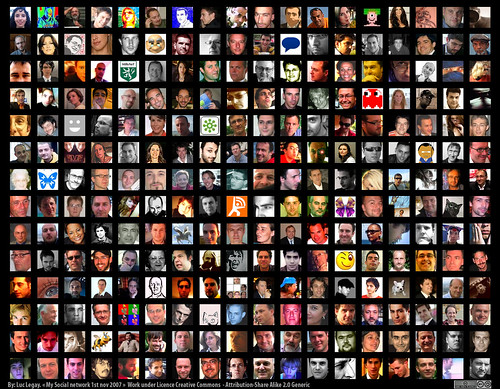
Images:

 w media advertising. The connection of audio and video allowed us to get a better idea (or perhaps question further) how interactivity affects advertising. Blogging allows people to comment on literally anyone's views. Twitter allows one to reply to anyone: celebrities, athletes, friends, strangers. It seems that with the advent of so many opportunities to express personal ideas through text and image, participation rates have increased dramatically.


 Posts


3 comments:
Becca- Brilliant when you say "Hundreds, no millions, of heads are better than one." I'm tempted to make this my course subtitle for next fall. You're so write. This is a succinct way of explaining participatory media. Nice post.
Hey Becca-It was interesting to see how someone who was so new media enveloped percieved the class. Before I took the class I had a facebook page and that was it. I never maintained a blog, designed a website, or created a podcast. I initially thought this class would be more of a "how to". To someone who as already done this it seemed like more of a "how to improve". Either way, I think we all settle that this class was also a "what", as in what is new media and what are the aspects of it, and a "why", as in why do people write new media in the way that they do.
Becca--
I really enjoyed reading your final post! Your images are wonderful and they really add to your reflections on new media. I especially enjoyed your discussion of publishing and how it has changed as a result of new media. I am hoping to have a career in book and magazine publishing after graduation, but after taking this class, I'm not sure what constitutes traditional publishing anymore.
You asked me where I see the future of text and image going. I'm not sure. In some ways, I can see images replacing text more and more. Looking at Twitter, seeing how even blogging has been reduced to "micro-blogging" makes me wonder if images will eventually replace text because a picture "says 1000 words." Can the evolution of art from massive history paintings to the sparse post-modern canvas be compared to the evolution of text from "War and Peace" to this comment on your blog? I guess we'll find out!
Post a Comment